Armboard
The armboard is one of the most recognisable parts on the LP12. It is the black rectangular piece that floats in the frame and where the tonearm is mounted on. On older LP12 turntables it features the very iconic "Linn Sondek" logo. Coincidentally the circle with the downwards pointing triangle is said to represent the single point bearing system used by the LP12.
The armboard is where the tonearm is mounted on and in turn the armboard is mounted, via three screws, to the sub-chassis. To a certain degree the armboard acts as a decoupling mechanism between the tonearm and sub-chassis. Many after-market options exist but many users will still gravitate to an original board to retain the iconic logo look and feel.
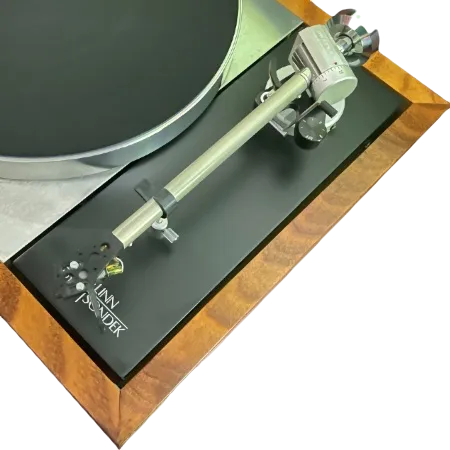
For comparison, here are the old and new armboards:
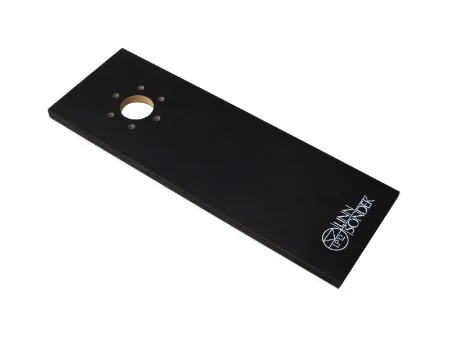
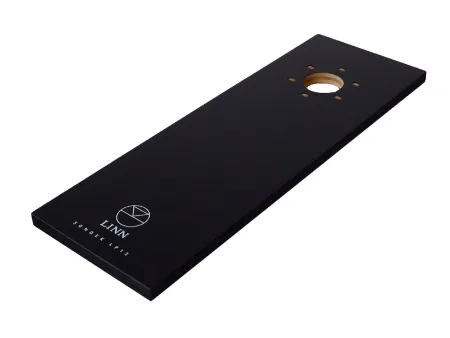
Through the years there have been many iterations of the standard board, with laminate layers added for additional stifness. One of the weak points of the older armboards is the risk of stripping the holes the screws go into. Tighten the self-tapping screws too much, and you risk damaging the bottom of the armboard. Since the position of the screws remains the same, stipping the holes means either fixing the holes with some sort of epoxy, resin, or similar. Worst-case scenario is replacing the entire armboard, a really expensive option. Later armboards are permanently mated to the sub-chassis.
Tonearm
The type of tonearm mounted on an LP12 is usually a large determining factor of the performance level of the turntable. Apart from Linn-branded arms that have been fitted to LP12 turntables, such as the Basik, Ittok, Akito, and Ekos units, many other third-party brands have also featured, such as SME, Mission, Mayware, Morch, Dynavector, Micro Seiki, and Jelco. An LP12 is sensitive to the weight of the tonearm and so it is not advised to attempt to fit particularly heavy arms on the turntable.
One of the most sought-after older tonearms is the Ittok. This is a serious piece of technology and despite being discontinued a long time ago, it has remained one of the most popular arms to go with a LP12. In South Africa you are unlikely to find a Ittok as a separate item. My advice is that if you see an older LP12 fitted with an Ittok, buy it, even if you only need the tonearm. Of course, we never know what the previous owners did with their turntables, and buying something so old will come with risks. It is what it is.
Ittok
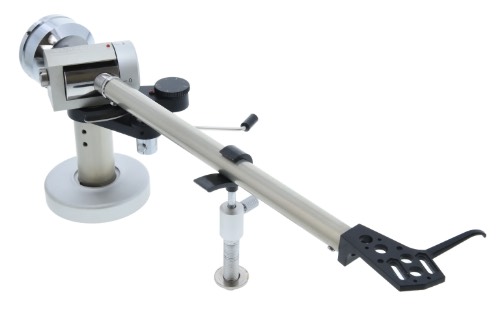
The Ittok has gone through stages of development with visual changes along the way. One of the more noticeable visual differences is the counterweight.
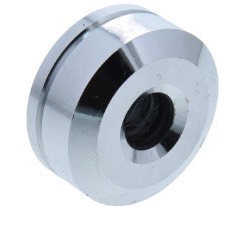
- Older versions had a split counterweight. This was ideal as it could be used for a variety of cartridges, especially really light cartridge bodies, where the ring could be removed. The idea is that while one wants the counterweight to be close to the arm's bearing, in certain cases it is impossible to balance the arm with the total counterweight in sito. Visually it may look as if the smaller ring is about 1/3/ of the size of the total counterweight, but it is not. The counterweight weighs 150 gram. Remove the ring, and the remaining unit weighs 123 gram. Thus, the ring weighs 27 gram.
- The later version did away with the split option and comes as a single piece, weighing 154 gram.
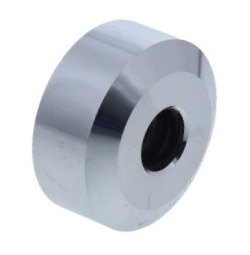
Which one is preferred? I guess it is a matter of visual appeal, but there is also a practical value. My turntable has a solid counterweight, supposedly meaning that I have one of the later versions of the tonearm. However, the previous owner may have exchanged a split unit with a solid one, so this is not an exact determining factor if you have an older or newer arm. Some argue that the solid counterweight reduces some "ring" that could be induced. Then again, the two grub screws should do their job holding the ring in place. Maybe it does not look all that great when you remove the ring because you are using a lighter cartridge, but this is trivial.
Some other changes the Ittok went through include the diameter of the collar (increased from 20 mm to 25 mm); the headshell drilled to accommodate the three-point fixing of some Linn cartridges, notably the Troika; a difference in the size of the headshell; and changes in the armrest, where older versions rely on a separate bracket located further forward, while later versions use an integrated arm rest, like the later Ekos Mk1, Mk2, and the current SE.
Slight differences
No two items will ever perform the same. I tested this recently when I had to install a cartridge on a LP12 we had for sale. My own turntable has a Audio Technica VM95ML MM cartridge fitted. We installed an almost exact same cartridge for the other turntable, with the same model Ittok arm. Now Audio Technica's VM95 series is great in that the range offers the entry-level 95C, then the 95E, the 95MN, 95ML, and finally the 95SH. The great thing is that you can change the stylus up and down the range without rebalancing the arm – they all weigh the same, irrespective of the stylus profile.
My own Ittok has a solid counterweight, weighing 154 gram. The other one has a split unit, 150 gram. For my life I just could not get the arm balanced without removing the ring. With the ring on, it was touching the bearing housing, and still would not float. With the ring take off, I managed to balance the arm and set the bias and tracking weight to the required 2 gram for this series of cartridges.
Why the difference? I do not know. I can only assume there must be slight variances in the bearing, the bias mechanism, or something else. Nevertheless, out of the box the AT VM95E is a great cartridge and it tracks beautifully.
As a final note, keep in mind that even if tonearms are very exact pieces of technology, we can relax and stop being overly pedantic. If the cartridge manufacturer specifies a tracking weight, let's say 1.7 gram to 2.0 gram, use the middle setting, 1.85 gram, with the bias set to the equivalent. If your arm's VTA is set visually correctly, keep it that way. Changing the VTA by 0.5 mm is never going to make any difference. No two vinyl records are ever going to be the same thickness (older MFSL pressings were often extremely thin), affecting tracking height and even the slightest warp will change the VTA at that part of the record. Different record weights mean different heights – 120, 140, 150, 180, and 200 gram. I am definitely not going to change the arm's VTA for every record I play.
Maybe Rega has the best solution. If you look at a Rega arm you will see the bias setting looks rather crude, with no exact calibration points. On some arms it uses a slider, with positions 0, 1, and 2 gram shown. How do you set a bias of 1.75 gram then? Just guess the position. Their stance is that if you have set the bias "more or less somewhere" between the two extremes set by the cartridge manufacturer, you are OK. I agree.